
Navigating the Rapids of Life

In 722 B.C., the Assyrians invaded Israel, the Northern Kingdom and took them captive. They never returned to the land. They are called the ten lost tribes. A century later, in 605 B.C., Babylon took the first captives from the Southern Kingdom, Judah. In 586 B.C., Jerusalem and the temple were destroyed and the southern tribe was taken into captivity. In 535 B.C., a remnant returned to Judah, but many remained in Babylon. It had become home to them. In 558-557 B.C., almost a century after the first remnant returned, another group returned from Babylon to Jerusalem led by Ezra.
Ezra is most likely the scribe-priest who collected the psalms and put them in order. He was among the exiles who were living in Babylon. For almost another hundred years (457-458 B.C.), they and their descendants were comfortable there. Then, Ezra, who was in the priestly line and had a copy of the sacred scrolls, was disturbed by something he read (Ezra 7:10). It changed his life. He altered his behavior, and he began to teach what God was revealing to him. The result was that many exiles could no longer be content to stay in Babylon. They wanted to go home, to a home they had never known – to Jerusalem. Ezra 8 tells the story of their journey from Babylon to Jerusalem. The succeeding chapters in Ezra reveal their impact on the city and the revival that followed with the open reading of God’s word in the public square, the repentance and the reordering of personal and family lives and the rebuilding of the walls of the city. This is how revival comes.
One man, Ezra, in prayer, over the scrolls, the word of God, had his heart stirred until the change in him was evident in his behavior. As he shared what he had encountered over the open scrolls, a spontaneous movement was generated. Suddenly, a remnant previously comfortable in Babylon wanted to go home – to Jerusalem. Arriving there, their devotion, their generous offerings and sacrifices caused a stir at the temple (Ezra 8:31-36). That was followed by the confession of the elders. They were convicted by the example of this remnant, confessing that they lived compromised lives. Their sons had married the daughters of the pagans around them, and likewise, the daughters had married the sons of pagans and “the holy seed was mixed.” There was no longer a distinction between the godly and the ungodly (Ezra 9:1-2).
Ezra pulled out his hair. He sat shocked by the confession. He prayed all day, until he sensed that God would grant “a little grace” (Ezra 9:3-8). Subsequently, there would be the open reading of God in the square, and the reordering of personal and family life (Ezra 10:1f). They would ‘tremble’ at the word of God. Eventually, Nehemiah would lead the rebuilding of the walls and the restoration of the city.
Watch the progress.
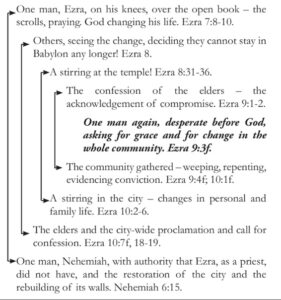
We must also determine to make the break from Babylon, from the world, and return to the Lord. He wants us to come home – to Him. That will demand sacrifice. It will demand changes in our personal lives, and family values and practices. It will not be an act, but a process. But such changes will bring God’s blessing.
As noted earlier, Ezra most likely collected the psalms and put them in order. He also wrote Psalm 1. In it he gives us a wonderful picture of how the lost blessing is restored. He begins the psalm with a blessing and ends it with the word perish. This is choice we have – to live a blessed life, or to experience a languishing life, where true joy and peace are far too rare. One in which we perish spiritually. Psalm 1 as a torah psalm, calls for us to engage with the law of God – that is a call to discipline, to pay attention to the boundaries. Remember, in violating the boundaries, we lose the blessing.
Looking at the end of the book, we discover that the last five psalms are those of total praise. This is how we are to end up! Blessed and blessing God, and so full of His presence that we can bless others.
Hallelujah! Praise God in His sanctuary. Praise Him in His mighty heavens. Praise Him for His mighty acts; praise Him for His excellent greatness. Praise Him with the sound of the trumpet…Let everything that has breath praise the LORD! Hallelujah! (Psalm 150).
This is living in the overflow. It is the end of the blessed life.
The first psalm challenges us to choose the right way – the way of blessing. Then, in Psalm 150, the last psalm, there is glorious victory and praise. However, in between, there are dozens of psalms that are called “psalms of lament.” They make up forty percent of all the psalms. These psalms are characterized by “Why God?” questions. They are tearful. They are at times frantic and despairing. They are not fluff. They are bare-knuckle desperate pleas that in the end recognize there is nowhere else to go besides God. So, despite the pain and the confusion, the writer turns to God with a kind of desperate trust. There is a pattern to these psalms. Some are psalms of order. Others of disorder. Still others of a new order. This is life. We move from a well ordered life, to times and places of disorder. We may feel abandoned by God. Then he leads us into a new place where our lives are reordered.
Psalm 1 sets the trajectory for the entire book of psalms. It helps us see how we are to navigate through the laments of life and end on our feet in praise (Psalm 150). In Psalm 2, the nations are raging. In Psalm 3, we find Absalom, David’s son, in rebellion against him and his kingdom. He is trying to take his father’s position. So, with nations raging against God (Psalm 2) and family life exploding (Psalm 3) – how do you keep your balance and retain the blessing and keep from perishing?
Ezra tells us, we must refuse to walk according to the counsel of the ungodly. Instead, we look for answers in the word of God. If we don’t, we will end up ‘standing’ in the way of sinners. Our progress stopped altogether. At a crossroads, without the counsel of God, we will take the wrong path! Soon, we are at a full stop, and we are sitting in the ‘seat of the scornful.’ Bitter, not blessed. Disillusioned, our faith is gone. We didn’t keep going by faith. We got the wrong advice and took the wrong path. Then, confused and disillusioned and angry, our progress was halted. We sat down – and quit. How many Christians do you know who have gotten unbiblical advice and taken the wrong road to end up bitter and confused? Has it ever happened to you?
What is the remedy? You meditate on the law of Lord. You reject bad counsel and “delight in the law of the Lord; and think about it day and night” (Psalm 1:2). This is not duty, but delight. Not spinach, but God’s word as dessert. It is not a have to, but a want to. You are transformed by the renewing of your mind (Romans 12:1-2). Notice Psalm 1, “And he will be like a tree planted by the rivers of water, which brings forth his fruit in his season; his leaf shall not wither; and whatever he does shall prosper.” We are suddenly back in Eden, in paradise, where we find rivers and fruit trees. Psalm 1 is the way home. The way to a life of victory. “His leaf shall not wither,” this is an evergreen tree. No foliage is lost in the fall. It is green even in the winter. And it bears fruit. The only Middle Eastern tree that fits this description is the olive tree from which the sacred anointing oil is produced. The tree in Psalm 1 is planted, with roots, by a stream. It is a tree that defies the seasons and is green all year round. A tree that produces fruit – that prospers. This is a rich picture of the blessing of God.
“The ungodly are not so.” They take the wrong path. They have no roots and become “like the chaff which the wind drives away.” They are carried about, this way and that, lacking any grounding. They “will not stand in the judgment, nor sinners in the congregation of the righteous.” In the end, those who take the wrong path, who listen to ungodly counsel, who get angry and bitter, will perish. “But the Lord knows the way of the righteous.” He is walking with you. He never leaves you – not even in seasons of disorder. He wants you to end up in Psalm 150. On your feet, praising Him.